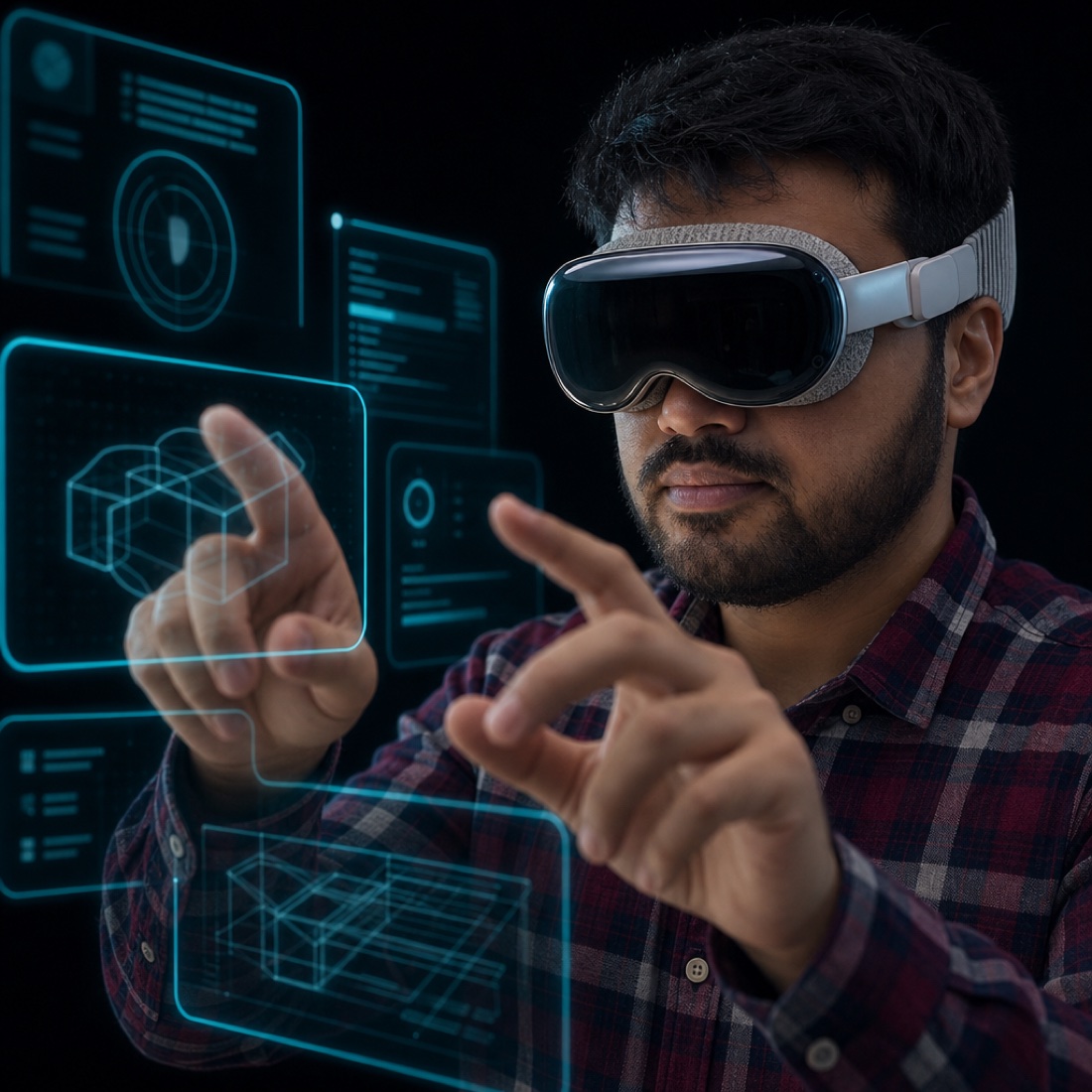
Resilient backend systems
REST and FastAPI services on Azure and AWS that sustained zero downtime during periods of increasing user demand. I also manage authentication, access control, observability, and incident response.
Available for full-time opportunities · Artesia, CA · Los Angeles area
I have six years of experience developing production backend services and integrating software with physical devices. My work includes Python APIs and microservices, embedded sensor systems on Raspberry Pi and Texas Instruments boards, and a computer-vision pipeline converted from PyTorch and TensorFlow to Core ML for quantized, 30 fps on-device inference.
Focus: Backend systems · device integration · on-device AI
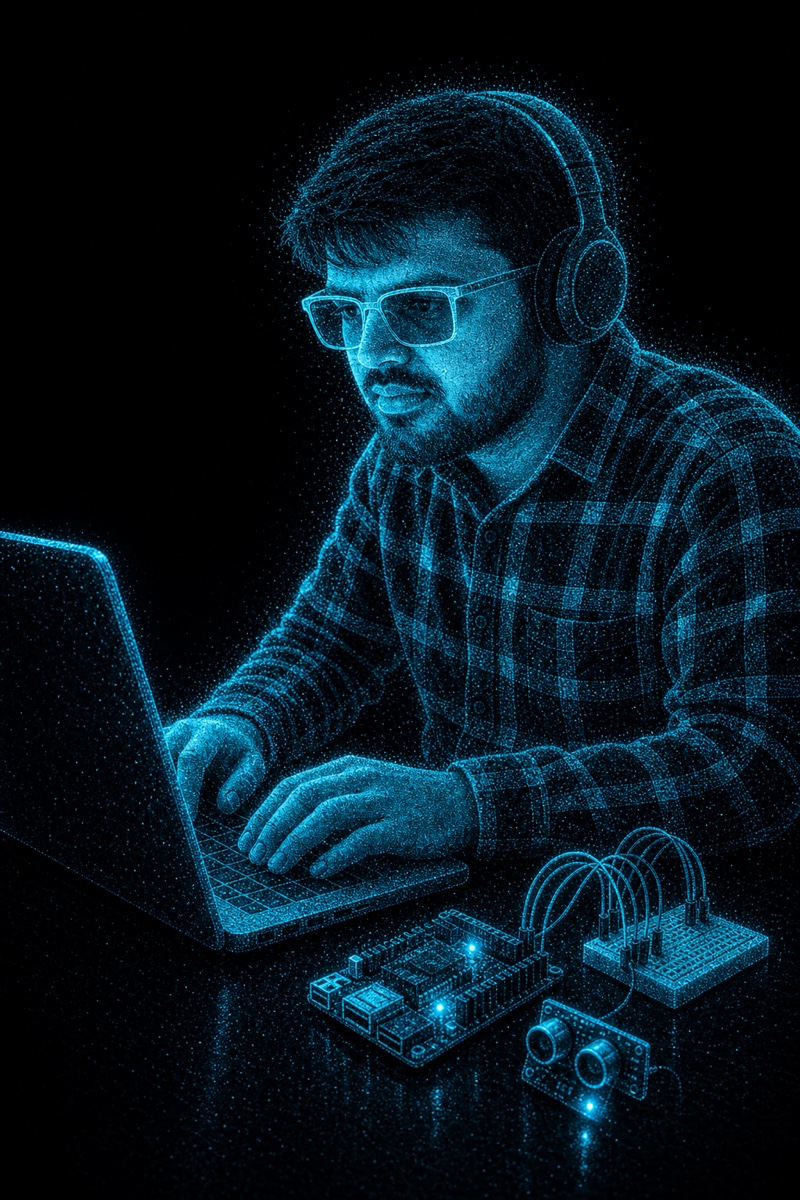
Abhijeet Gajjar
Software Engineer · Backend systems · device integration · on-device AI
02 / Research direction
Most AI tools operate remotely: a request travels to a data center, a model processes it, and the response returns to the user. This requires a live connection, introduces latency, and transfers user data outside the device.
Two developments are changing this model: open weights that can be inspected and deployed independently, and quantization techniques that allow capable models to run on mobile and embedded hardware. Together, they enable intelligence that is both local and more inspectable.
This is the direction of my current work. I have converted a production computer-vision model from PyTorch and TensorFlow to Core ML, tuning quantization to hardware constraints and achieving 30 fps on-device inference. The next stage is applying the same principles to language models.
Core capabilities
I develop reliable systems across software, hardware, and machine learning.
REST and FastAPI services on Azure and AWS that sustained zero downtime during periods of increasing user demand. I also manage authentication, access control, observability, and incident response.
Peripheral discovery, live sensor telemetry, offline persistence, and automatic state reconciliation after reconnection. Experienced with GPIO, I2C, SPI, UART/RS-232, and USB on embedded Linux.
Production agentic pipelines using LangChain and LangGraph, alongside vision models converted to Core ML and quantized for 30 fps on-device inference. Current research focuses on efficient local language models.
Featured project
Designed and delivered independently from concept to production.
Dwelio is an AI-enabled system that automates the property maintenance workflow from request intake through vendor sourcing, bidding, and completion.
I designed and delivered each layer: the FastAPI backend, the OpenAI and SendGrid agent that sources and negotiates with vendors by email, and the React Native applications for iOS and Android.
This project demonstrates end-to-end ownership: translating an ambiguous problem into a data model, production services, agent workflows, and released applications.
The product is available on the web, TestFlight, and Google Play. The backend, agent workflow, and mobile applications were delivered by one engineer.
 FastAPI
 PostgreSQL
 OpenAI
 React Native
 AWS
AWSSolo
End to end
3
Live platforms
0
Humans in the loop
Full
Workflow automated
04 / Selected work
Each entry describes the system, my contribution, and the resulting impact. Live links are provided where available.
01
30 fps on-device inference
Production · On-device · Applied in production
30 fps
An end-to-end computer vision pipeline built in PyTorch and TensorFlow, converted to Core ML, with quantization tuned to the hardware's constraints.
 PyTorch
 TensorFlow
 Core ML
 Swift
Swift02
Delivered to two enterprise clients
Enterprise · Cross-platform · Client delivery
2 clients
A cross-platform instrument-monitoring application that discovers IoT peripherals over Core Bluetooth and native Android BLE, manages their connections, and acquires live temperature and gas sensor readings.
 Core BluetoothAndroid BLESwift
 Kotlin
 REST
REST03
AI property maintenance platform
Solo · End to end · 2024 — Present
Live today
An AI system that automates the full property maintenance workflow: request intake, vendor sourcing, bidding, completion.
FastAPIPostgreSQLOpenAIReact NativeAWS04
Innovation to Impact Award
Rural India · Healthcare · Field deployment
Award winner
An application rural healthcare workers across India use to track pregnancies and flag high-risk cases.
05
Personal hardware work
Raspberry Pi · TI boards · Ongoing
Working MVPs
Working prototypes and MVPs on Raspberry Pi and Texas Instruments boards — interfacing sensors and peripheral devices over GPIO, I2C, SPI, UART/RS-232, and USB.
 Python
06
Healthcare staffing marketplace
Québec, Canada · Mar 2020 — Apr 2022
100K+ registrations
100,000+ registrations · 10,000 daily active users. Migrated a legacy Objective-C codebase to Swift through incremental module bridging.
SwiftPyTorchTensorFlowObj-CLab / Device integration
Practical work with Raspberry Pi, Texas Instruments boards, BLE sensors, serial communication, GPIO, and on-device inference.
Delivered to two enterprise clients with offline-first operation.
A device-monitoring application that discovers sensors, maintains connections, buffers readings during network interruptions, and synchronizes data when connectivity returns.
Core BluetoothBLESwiftKotlinRESTFunctional prototypes for personal research.
Functional prototypes on Raspberry Pi and Texas Instruments boards, with sensors connected over GPIO, I2C, SPI, UART, and USB and controlled with Python on the device.
PythonStack
Languages, backend frameworks, embedded protocols, data systems, cloud platforms, and AI/ML tools grouped by practical use.
PythonFastAPISwiftCore ML LangGraphPostgreSQLAWS
 Azure
Azure10 / Contact
I welcome inquiries regarding backend systems, device integration, and on-device AI engineering opportunities.
Full-time · Los Angeles area
gajjarabhijeet@gmail.com(562) 215-3250Artesia, CA